Choosing between a salon suite and a single chair rental in the Bay Area is one of the biggest financial decisions you’ll make as a stylist. Both options promise independence and the chance to build your own client base, but the real costs go far beyond the monthly rent number you see advertised. Hidden fees, utilization rates, and Bay Area-specific factors like parking and commute times can completely change which option actually saves you money.
For most stylists working in San Francisco, a single chair rental is cheaper when you’re building your book or working part-time, while a salon suite becomes more cost-effective once you consistently fill 20 or more hours per week with clients. The math shifts based on your volume, service prices, and how much you value privacy versus shared amenities. What looks like a bargain on paper can become expensive fast if you don’t account for utilities, supplies, and the cost of empty hours.
This breakdown walks you through the actual numbers, real scenarios at different volume levels, and the Bay Area adjustments that matter when you’re comparing options near Kosa Salon SF in the Marina District. You’ll see exactly how to calculate your own break-even point and which model fits your business stage and income goals.
Quick Answer: Which Is Cheaper For Most Stylists?
For most stylists in the Bay Area, booth rental costs less upfront at $150 to $300 per week, while salon suites run $250 to $500 per week. Your career stage and client volume determine which option saves you more money in the long run.
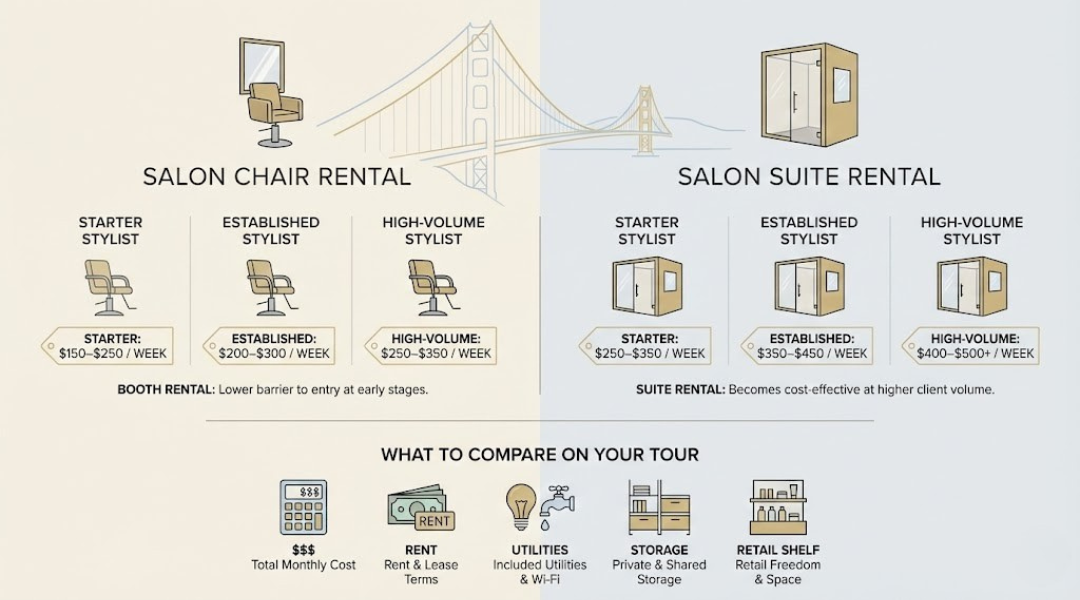
Summary Verdict By Stylist Type (Starter, Established, High-Volume)
Starter stylists should choose booth rental. You’ll pay less rent while building your client base. The lower fixed costs give you breathing room when your schedule isn’t fully booked yet. You can’t afford to lose money on empty suite time when you’re just getting started.
Established stylists with consistent bookings face a closer decision. You’ll spend $1,000 to $1,300 monthly on booth rental versus $1,200 to $2,000 for a suite in the Bay Area. The suite costs more but lets you keep 100 percent of retail sales and upsells. If you sell products or offer premium services, the extra income often covers the higher rent.
High-volume stylists save more with suites. You need the extra room for multiple service areas and product inventory. The private salon space lets you raise prices without pushback. Your clients expect a premium experience at your rates, and a suite delivers that better than a shared booth.
How To Use This Article (What To Compare On Your Tour)
When you tour potential spaces, bring a calculator and your current income numbers. Write down the weekly rent for each option. Add your supply costs, insurance, and software fees. Compare the totals against what you actually take home now.
Ask about hidden fees before you sign anything. Some booth rentals charge extra for storage or utilities. Suite leases might include these costs or bill them separately. Get the full monthly amount in writing.
Look at the physical differences that affect your income potential. A private suite lets you sell retail without sharing commissions. You can also book clients during off-peak hours that shared salons don’t allow. These advantages only matter if you’ll actually use them to make more money.
Key Cost Components To Compare
When you’re deciding between a salon suite and a single chair rental in the Bay Area, you need to look beyond the monthly rent number. Your actual costs include utilities, equipment, compliance fees, and several expenses that aren’t always obvious at first glance.
Base Rent And Utility Allocation
Salon suites in San Francisco typically charge between $1,200 and $2,500 per month depending on location and square footage. This rate usually includes utilities like water, electricity, and HVAC in a single flat fee. You get predictable monthly costs without surprise bills.
Chair rentals at traditional salons range from $300 to $800 per week in the Bay Area, which adds up to $1,200 to $3,200 monthly. Some salons include utilities in this price, but others charge extra for electricity if you use high-powered tools or keep lighting on during evening appointments. You should always ask how utility costs are calculated before signing any agreement.
The key difference is that suite rent stays the same regardless of your utility usage, while chair rental can include separate utility charges that vary each month.
Furnishing, Backbar, And Equipment Costs
A salon suite arrives as an empty room. You need to buy your own styling chair, shampoo bowl, storage cabinets, mirrors, and lighting fixtures. This initial investment typically costs $3,000 to $8,000 depending on whether you buy new or used equipment. You also purchase all backbar products, towels, capes, and styling tools yourself.
Chair rentals usually come fully furnished. The salon owner provides the chair, mirror, lighting, and basic equipment. You bring your own scissors, blow dryer, and preferred styling products. Your upfront costs stay much lower, often under $500 to start working.
You own everything you buy for a suite, which means you can take it with you if you move. Chair rental equipment stays with the salon when you leave.
Insurance, Licensing, And Health Compliance
Both options require you to maintain an active California cosmetology license and liability insurance. Your professional liability insurance costs between $150 and $400 per year regardless of where you work.
Salon suites require you to register your business with the California Board of Barbering and Cosmetology as an independent establishment. This registration costs approximately $125 every two years. You’re responsible for passing all health inspections and maintaining compliance with state sanitation standards on your own.
Chair renters work under the salon’s existing establishment license. The salon owner handles inspections, compliance paperwork, and ensures the space meets health department requirements. You still need your individual license, but you don’t register a separate business establishment.
Marketing, Booking Tools, And Payment Fees
Suite owners build their client base independently. You pay for your own booking software, which typically costs $25 to $50 per month for platforms like Vagaro or Boulevard. Payment processing fees run 2.6% to 3.5% per transaction. Your marketing budget for social media ads, business cards, and website hosting adds another $50 to $200 monthly.
Chair renters may use the salon’s existing booking system at no extra cost, though some salons charge a small monthly fee. You keep 100% of your service revenue but handle your own payment processing fees. The salon’s existing reputation and foot traffic can help you attract new clients without spending heavily on marketing initially.
Hidden Fees: Cleaning, Waste Disposal, Repairs
Salon suites require you to clean your own space or hire a cleaning service. Professional cleaning costs $80 to $150 per visit if you schedule it weekly or biweekly. You also arrange and pay for waste disposal, including color waste and hair clippings, which must follow Bay Area environmental regulations.
When equipment breaks—like a malfunctioning shampoo bowl or flickering lighting—you pay for repairs or replacements yourself. A plumber visit starts around $150, and electrical work costs even more in San Francisco.
Chair rentals include cleaning services provided by the salon. The owner maintains all equipment and handles repairs at no cost to you. Waste disposal is managed by the salon. These included services save you time and unpredictable repair bills throughout the year.
Revenue And Utilization Variables That Change The Math
Your break-even point shifts dramatically based on how much you earn per client and how often you fill your chair. Beauty professionals in the Bay Area need to track these numbers closely because they determine whether a salon suite or single chair rental makes financial sense.
Average Ticket And Retail Per Client
Your average ticket price directly impacts how many clients you need to break even each month. If you charge $150 per haircut in a salon suite versus $100 in a shared space, you’ll need fewer appointments to cover your costs.
Typical Bay Area pricing breakdown:
| Service Type | Lower Range | Higher Range |
|---|---|---|
| Basic cut | $75 | $120 |
| Color service | $150 | $350 |
| Highlights | $200 | $450 |
Retail sales add to your revenue without requiring more chair time. If you sell $30 in products per client and see 20 clients weekly, that’s an extra $600 monthly toward your fixed costs. Beauty professionals who actively recommend products can increase their average ticket by 15-25%.
Chairs Per Hour And Weekly Utilization Rate
Your utilization rate measures how many hours you actually have clients versus available hours. A salon suite costs the same whether you work 20 or 40 hours weekly, but a chair rental only charges for hours used.
Most beauty professionals maintain 60-75% utilization during busy periods. If you book 25 clients weekly at 90 minutes each, you’re using about 37.5 hours. A single chair rental at $35 per hour costs $1,312 weekly. A salon suite at $1,600 monthly ($400 weekly) becomes cheaper once you exceed 11.5 hours weekly.
Peak utilization happens differently for each professional. Some fill evenings and weekends while maintaining lower weekday traffic.
Upsells, Add-Ons, And Passive Retail Income
Additional services boost revenue without extending appointment times significantly. A $25 deep conditioning treatment takes 10 minutes but increases your hourly rate. Gloss treatments, scalp massages, and styling products serve as easy upsells.
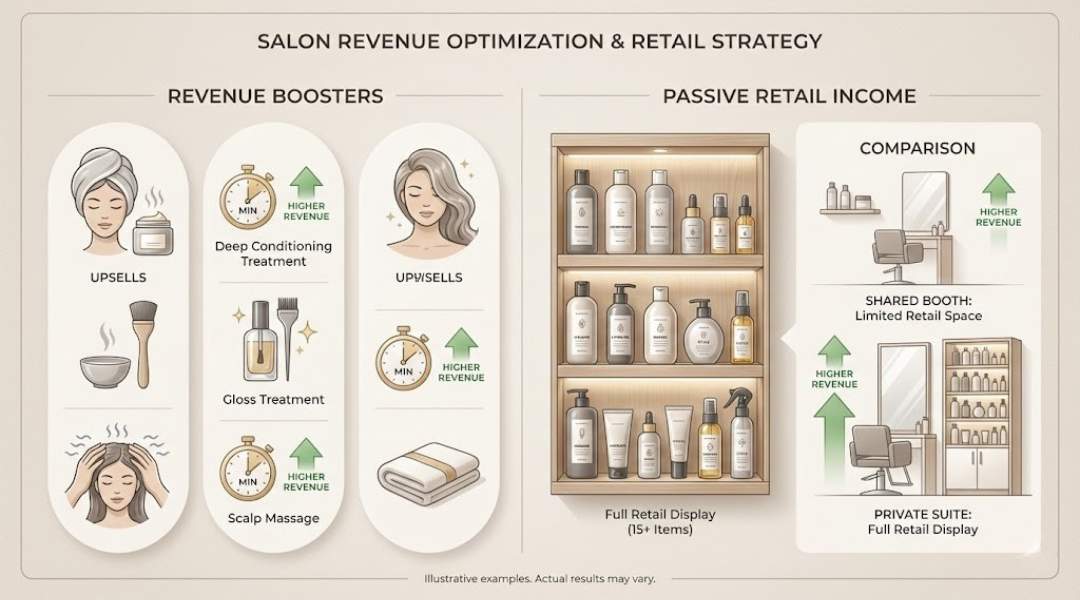
Passive retail income from product displays works better in salon suites where you control the space. Setting up a retail shelf with 10-15 products can generate $200-500 monthly without active selling. You keep 100% of retail profits in a suite versus potentially splitting commissions in a shared salon.
Beauty professionals who add just one upsell per day at $20 generate an extra $400-500 monthly. This revenue helps cover the cost difference between rental options without requiring more clients.
Sample Scenarios: Real Numbers (Low / Mid / High Volume)
Breaking down actual costs and revenue for three different business volumes shows which rental option saves you more money. These scenarios use typical Bay Area pricing to compare monthly profit and loss for stylists at different career stages.
Scenario A: Starter Stylist — Monthly P&L
Single Chair Rental: $1,200/month
You serve 40 clients per month with an average ticket of $85. Your monthly revenue reaches $3,400.
- Revenue: $3,400
- Chair rent: $1,200
- Product costs: $340 (10% of revenue)
- Supplies: $150
- Parking/transit: $100
- Marketing: $200
- Net profit: $1,410
Salon Suite: $1,800/month
With the same 40 clients at $85 each, you generate $3,400.
- Revenue: $3,400
- Suite rent: $1,800
- Product costs: $340
- Supplies: $150
- Utilities: $120
- Insurance: $80
- Marketing: $200
- Net profit: $710
The single chair rental saves you $700 per month at this volume. Your overhead is 65% lower with a chair rental, making it the better choice when you’re building your client base.
Scenario B: Mid-Growth Stylist — Monthly P&L
Single Chair Rental: $1,400/month
You now see 75 clients monthly at an average of $95 per service. This brings your revenue to $7,125.
- Revenue: $7,125
- Chair rent: $1,400
- Product costs: $712
- Supplies: $250
- Parking/transit: $100
- Marketing: $300
- Assistant tips: $200
- Net profit: $4,163
Salon Suite: $2,000/month
With 75 clients at $95 each, you earn $7,125 in revenue.
- Revenue: $7,125
- Suite rent: $2,000
- Product costs: $712
- Supplies: $250
- Utilities: $120
- Insurance: $80
- Marketing: $300
- Decor/maintenance: $150
- Net profit: $3,513
The chair rental still wins by $650 monthly. You keep 58% of your revenue with a chair versus 49% in a suite.
Scenario C: High-Volume Stylist — Monthly P&L
Single Chair Rental: $1,600/month
You book 120 clients per month at $110 average. Your monthly revenue totals $13,200.
- Revenue: $13,200
- Chair rent: $1,600
- Product costs: $1,320
- Supplies: $400
- Parking/transit: $100
- Marketing: $400
- Assistant wages: $800
- Net profit: $8,580
Salon Suite: $2,200/month
At 120 clients and $110 per service, you generate $13,200.
- Revenue: $13,200
- Suite rent: $2,200
- Product costs: $1,320
- Supplies: $400
- Utilities: $140
- Insurance: $80
- Marketing: $400
- Assistant wages: $800
- Maintenance: $200
- Net profit: $7,660
The chair rental advantage grows to $920 per month. Even at high volume, you save $11,040 annually with a chair rental over a suite.
Break-Even And Payback Timeline
Understanding when your initial investment pays off helps you choose between a salon suite and a chair rental. The timeline to recover your costs varies significantly based on setup expenses and your monthly revenue.
One-Time Setup Vs Recurring Costs
A chair rental typically requires $500 to $2,000 in upfront costs for basic supplies, tools, and minimal decor. Your recurring monthly expense stays fixed at your rental rate, usually $300 to $800 in the Bay Area. You face minimal financial risk since you’re not responsible for major buildouts or permanent fixtures.
Salon suites demand much higher initial investment. You’ll spend $5,000 to $15,000 on furniture, equipment, décor, and potentially small renovations. Some suites come semi-furnished, reducing your startup costs to $3,000 to $8,000. Your monthly recurring costs include rent ($1,200 to $3,500 in San Francisco), utilities ($100 to $300), and supplies.
Key cost differences:
- Chair rental: Low upfront, predictable monthly expense
- Salon suite: High upfront, variable monthly expenses
- Chair rental suits stylists testing the market
- Salon suites reward established client bases
How Many Clients Or Weeks To Recoup Build-Out Costs
With a chair rental’s $1,500 average setup cost and $100 contribution per client after expenses, you break even in 15 clients. If you service 20 clients monthly, you recover costs in under one month.
A salon suite with $10,000 in buildout costs takes longer. At $120 contribution per client (higher prices minus suite expenses), you need 84 clients to break even. With 25 clients monthly, your payback period stretches to 3.4 months. With 40 clients monthly, you recoup costs in 2.1 months.
Your margin of safety matters too. If you drop from 40 to 25 clients in a suite, you still cover operating costs but extend your payback timeline significantly.
Non-Financial Considerations That Affect Value
Beyond monthly costs, your choice between a salon suite and chair rental shapes your daily work experience and professional growth in ways that numbers alone can’t capture. These factors influence client relationships, business control, and long-term opportunities.
Privacy And Branding (Suite Advantage)
A salon suite gives you complete control over your space and brand identity. You can choose your own decor, music, lighting, and product lines without asking permission. Your clients get a private, one-on-one experience that many prefer for personal services like color corrections or consultations.
You set your own hours and don’t need to coordinate with other stylists. This independence matters when building a loyal client base that identifies your services with your personal brand. In the Bay Area’s competitive market, this differentiation helps you stand out.
The door to your suite also means clients aren’t exposed to other stylists’ work or pricing. You control the entire client journey from booking to checkout.
Community And Foot Traffic (Chair Advantage)
Renting a chair at an established salon like Kosa Salon SF connects you to an existing client base and professional network. Walk-in traffic from the salon’s location and reputation can fill gaps in your schedule without additional marketing costs.
You work alongside other professionals who can cover your clients during vacation or refer overflow appointments. This built-in support system matters for newer stylists building their business. The shared environment also provides learning opportunities through observation and conversation.
Salon-provided front desk staff handle phone calls, booking, and some client service tasks. This removes administrative burden that you’d handle alone in a suite.
Flexibility, Lease Terms, And Exit Options
Suite leases typically run 6-12 months with stricter exit terms. Breaking a suite lease early can cost you thousands in penalties. Chair rentals often operate month-to-month or with shorter 3-6 month agreements.
If you need to relocate, change your business model, or step away from your career, chair rental offers easier transitions. You’re not responsible for the space buildout or major equipment investments. Your financial exposure stays limited to your immediate rental period and personal supplies.
Chair arrangements also let you test the Bay Area market before committing to a larger investment. You can evaluate neighborhoods, client demographics, and your earning potential with less risk.
Bay Area Local Factors To Adjust For
Location within the Bay Area significantly affects your rental costs and operating expenses. San Francisco operates under different rules and price points than neighboring regions, and your choice of location will impact both your overhead and your ability to attract clients.
San Francisco Pricing And Permitting Realities
San Francisco rental rates are typically 30-50% higher than other Bay Area locations. A salon suite in the city often costs $1,800 to $3,500 per month, while single chair rentals run $800 to $2,000 weekly.
You’ll need to factor in permit costs and compliance requirements specific to San Francisco. Business registration fees, health permits, and cosmetology establishment licenses add $500 to $1,200 annually to your operating costs. The city requires separate permits for signage, which can cost $200 to $600 depending on your location and type of display.
Rent control doesn’t apply to commercial spaces, but you should still negotiate lease terms carefully. Many San Francisco landlords require personal guarantees and first month, last month, plus security deposit upfront.
Peninsula And East Bay Cost Differentials
Peninsula cities like Palo Alto and San Mateo charge rental rates 20-30% below San Francisco prices. You’ll find salon suites for $1,200 to $2,400 monthly and chair rentals from $600 to $1,400 weekly in these areas.
East Bay locations including Oakland, Berkeley, and Walnut Creek offer even lower base costs. Salon suites here typically range from $900 to $2,000 per month. The trade-off is potentially smaller client bases in some neighborhoods, though areas near BART stations maintain strong foot traffic.
Cost comparison by region:
- San Francisco: Highest rates, most foot traffic, strictest regulations
- Peninsula: Mid-range pricing, affluent client base, parking usually included
- East Bay: Lowest base costs, growing markets, more flexible lease terms
Parking, Transit Access, And Client Willingness To Travel
Clients in San Francisco expect easy transit access and will travel farther if you’re near BART or Muni lines. Locations within two blocks of major transit stops command premium rents but attract more walk-in business.
Parking availability directly affects your client retention outside San Francisco. Peninsula and suburban East Bay clients typically drive, and they’ll skip appointments if parking is difficult or expensive. If your location lacks dedicated parking, you’ll lose clients to competitors who offer it.
You should budget $150 to $300 monthly if you need to validate client parking in San Francisco. Some buildings include parking in commercial leases, but most charge separately. East Bay and Peninsula locations usually provide free lot parking, eliminating this expense entirely.
How To Run The Comparison On Kosa Salon SF’s Listings
When you visit Kosa Salon SF to compare suite and chair rental options, bring a checklist and ask direct questions about hidden costs. The numbers you confirm during your tour determine whether a suite or single chair makes financial sense for your business.
Quick Checklist To Bring On Your Tour (Numbers To Confirm)
Write down the base monthly rent for each option you consider. Ask if the rate includes utilities, Wi-Fi, and water or if those add to your bill. Confirm the security deposit amount and whether it’s refundable.
Check the square footage of suites versus chair spaces. Measure where you’ll store products, tools, and retail inventory. Note if storage is included or costs extra.
Ask about parking availability for you and clients. Downtown San Francisco parking can cost $200-$400 monthly at nearby lots. If the salon offers parking, factor that savings into your comparison.
Confirm lease length requirements. Month-to-month agreements offer flexibility but may cost more than six- or twelve-month commitments. Get the cancellation policy in writing so you understand your exit options if the space doesn’t work.
Questions To Ask About Utilities, Maintenance, And Trial Days
Ask if electricity, water, and heat are included in your rent or billed separately. Some salons divide utility costs among all renters, which can fluctuate by season and usage.
Find out who handles cleaning, repairs, and equipment maintenance. If the salon covers common areas but you manage your suite, calculate the cost of cleaning supplies or hiring help.
Request a trial day or week before signing. This lets you test the space, evaluate client access, and confirm the environment fits your work style. Some salons charge a daily rate for trials, which you can compare against your expected revenue.
Ask if insurance requirements differ between suite and chair rentals. Suites may require higher liability coverage because you control more space and equipment.
Decision Checklist: Which Choice Fits Your Business Model
Your business model determines which rental option makes financial sense. A salon suite works best if you want full control over your brand and pricing, while a chair rental suits those who need lower upfront costs and access to walk-in clients.
If You Value Brand Control And Predictability
A salon suite gives you complete control over your business identity. You set your own prices, choose your products, and design your space to match your vision. This matters in the Bay Area where clients often pay premium rates for personalized experiences.
You also get predictable monthly costs. Your rent stays the same regardless of how many clients you serve. This makes budgeting easier compared to commission-based models where your income fluctuates.
Key benefits include:
- Full control over service pricing and scheduling
- Private space for one-on-one client relationships
- Ability to retail your own product lines
- Freedom to build your personal brand without restrictions
You need to handle all aspects of your business, from marketing to cleaning. This requires more time and effort but gives you greater profit potential. In San Francisco’s competitive market, this independence helps you stand out and build a loyal client base.
If You Value Low Startup Costs And Walk-In Traffic
Chair rental requires less money upfront. You pay weekly or monthly rent without needing to stock a full suite with products and furniture. The salon typically provides basic amenities like reception services and utilities in your rental fee.
Walk-in traffic gives you immediate access to potential clients. Established salons in San Francisco already have foot traffic and brand recognition. You benefit from their marketing efforts and existing customer base without spending your own money on advertising.
Main advantages include:
- Lower initial investment (typically just rent deposit and basic tools)
- Built-in client flow from salon’s reputation
- Shared costs for utilities and common areas
- Less responsibility for business operations and maintenance
You trade independence for lower risk. The salon sets operating hours and may limit which products you can use. Your pricing might need approval, and you share space with other stylists. This works well if you want to focus on building skills rather than managing a full business.